
app ideas
from my
books
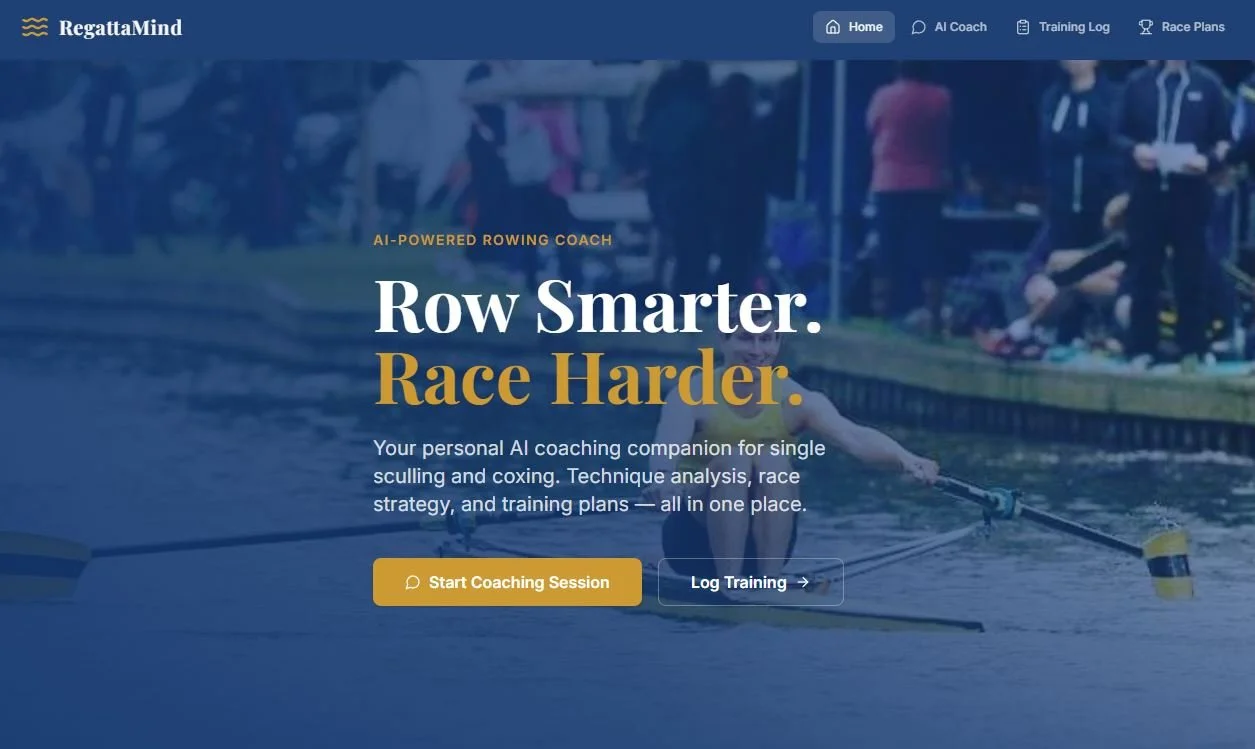
RegattaMind: Where Fiction Meets the Future of Rowing
RegattaMind first appeared in the pages of Jonty's Jaunts and Aly's Webcam Moments, published in 2026 by Alexander Paul Burton writing as Bradley Conrad Jr. What began as a fictional AI coaching platform dreamed up for the novel's world has taken on a life of its own as a concept that feels entirely real, entirely plausible, and entirely ahead of its time.
In the world of those novels, RegattaMind is the app that changes everything for its users. Designed specifically for single scullers and coxes, it combines conversational AI coaching, intelligent training logs, and dynamic race planning into one beautifully designed platform. Think of it as having an Olympic-level rowing coach in your pocket, one who never sleeps, never loses patience, and always has your split times memorised.
What RegattaMind Does
The AI Coach feature sits at the heart of the app. Rowers open a session the way they might message a trusted mentor, describing how a piece felt, asking about blade extraction, talking through a race that went sideways. The AI responds with technique analysis drawn from biomechanical data, personalised cues based on the rower's logged history, and targeted drills to address specific weaknesses. No generic advice. No one-size-fits-all programmes. Just coaching that actually knows you.
The Training Log is where every session lives. Distance, rate, split, conditions, feel score, video notes. The app builds a picture of a rower's development over weeks and months, and the AI draws on that data continuously, spotting patterns a human coach might miss across a full season of training.
Race Plans takes the intelligence further. RegattaMind helps rowers and coxes build split-by-split race strategies based on course conditions, competitor analysis, and the rower's own power profile. It models different rating strategies, projects finishing times, and helps coxes build their calls in advance so race day feels rehearsed rather than reactive.
Born in a Novel, Built for the Water
There is something rather wonderful about a piece of technology being imagined into existence through fiction first. RegattaMind exists because a story needed it to exist, because the characters in Jonty's Jaunts and Aly's Webcam Moments deserved a world that felt fully realised, technically credible, and emotionally true to the sport they loved. Rowing is a sport of extraordinary precision and extraordinary feeling, and RegattaMind was designed, even fictionally, to honour both.
REELBOUND
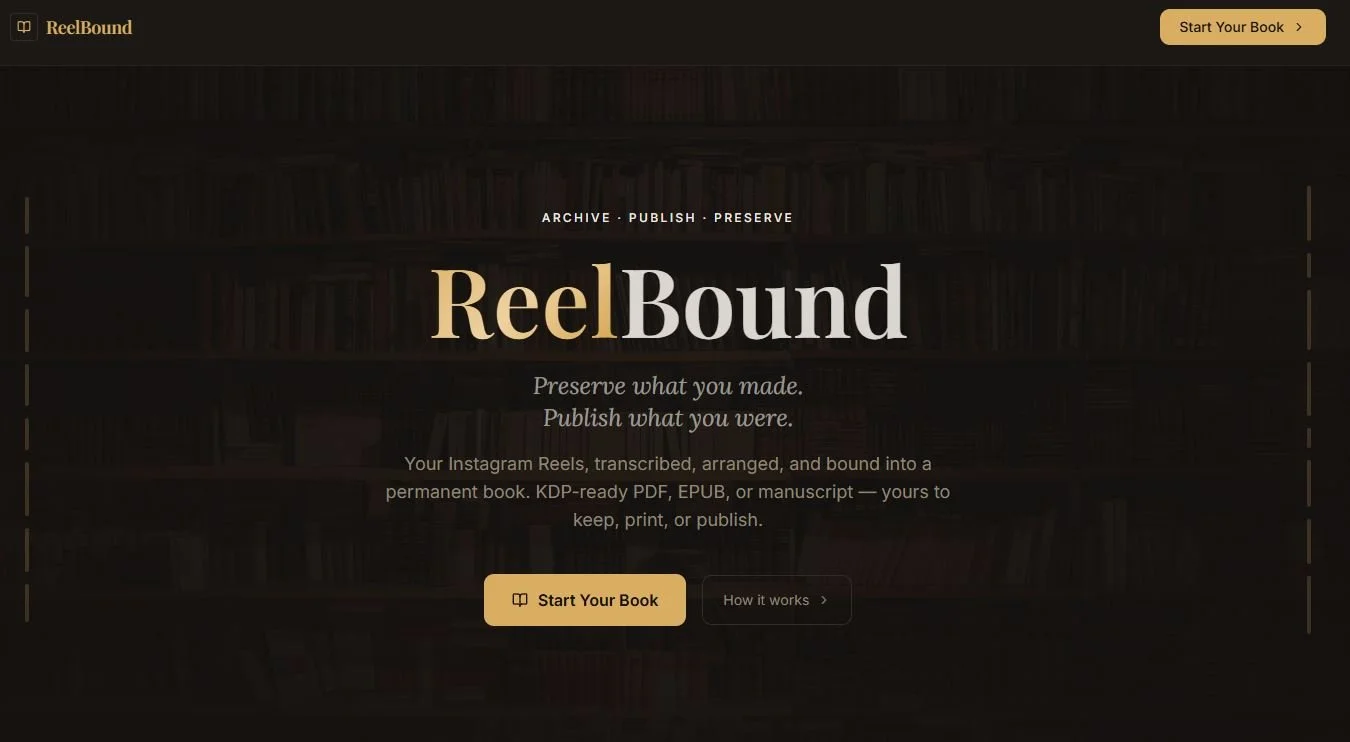
Preserve what you made. Publish what you were.
What it is
ReelBound is a web application that connects to a user's Instagram account, processes their Reels, videos, and captions using transcription and language AI, and produces a formatted, publish-ready book document that archives their creative output as a readable, permanent record. The output can be downloaded as a KDP or IngramSpark-ready PDF, or as a formatted manuscript. It turns an ephemeral social media presence into a physical or digital book that can be self-published, gifted, deposited in a library, or simply kept as a personal archive.
The problem it solves
Millions of creators have invested thousands of hours building a body of work on Instagram. That work -- the ideas, the voice, the evolution, the craft -- exists entirely at the mercy of a private platform. When accounts are deleted, hacked, banned, or simply abandoned, everything disappears. There is no tool that captures not just the files but the meaning of what someone built, and turns it into something that outlasts the platform.
Core features
Instagram connect and import -- The user connects their account or uploads their Instagram data export ZIP file. ReelBound reads all Reels, videos, captions, dates, locations, and hashtags.
Audio transcription -- Each Reel's audio is transcribed automatically, capturing the spoken content, narration, or dialogue. This becomes the text body of each entry.
AI summarisation and description -- Where audio is music-only or ambient, the AI reads the caption and metadata and writes a descriptive paragraph about what the content was and what it appeared to be doing creatively.
Timeline assembly -- All content is arranged chronologically, with the option to group by month, year, theme, or hashtag series.
Book format selection -- The user chooses from several output formats: memoir/diary style, thematic anthology, catalogue raisonné, or legacy document.
Cover and title generation -- A simple cover is generated with the creator's name, account handle, date range covered, and chosen title.
Export -- Output as a KDP-ready PDF (6x9 or chosen trim size with correct bleed and margins), an IngramSpark-ready PDF, an EPUB, or a plain Word document.
Output book formats available
The Diary -- Chronological, personal, month-by-month. Each entry has the date, a thumbnail description, the transcription or AI caption, and the original caption text. Reads like a creative journal.
The Anthology -- Content clustered by theme or hashtag series. A food creator gets chapters by dish type. A travel creator gets chapters by country. Structured like a curated collection.
The Catalogue -- Formal record. Date, title, duration, transcript, engagement snapshot, context note. Closest to an artist's archive document. Suitable for library deposit.
The Legacy Book -- Simplified, warm, designed to be understood by someone who never saw the original content. Written in plain prose. Suited to family preservation or estate documentation.
Second course
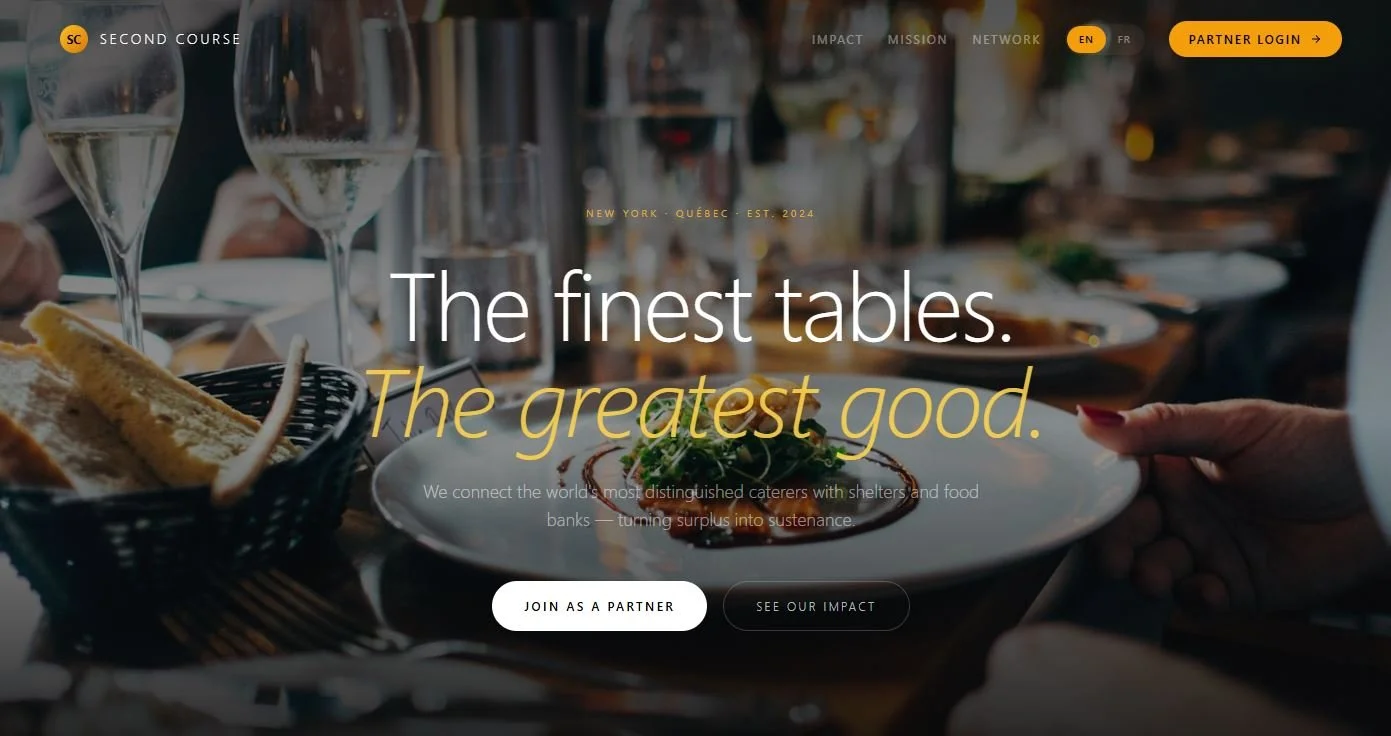
Second Course: From The George Files
A Michelin-starred wedding. A black-tie gala at Cipriani. A private launch on the 70th floor. These events produce extraordinary food — and far too often, extraordinary waste.
Second Course exists at the precise intersection of culinary luxury and civic responsibility. We've built the logistics, the relationships, and the platform so that caterers can act with ease — and communities can count on consistency.